Betcha is bold. To say the least. The founder Nick Jenkins is either crazy, brilliant, or, like many founders, both. Betcha is a platform for peer to peer betting not unlike gottabet, betfair, or intrade. Except for two (intimately related) details: (1) all debts are on the honor system, and (2) it’s based in Seattle, WA, UIGEA. Betcha makes no bones about it ( no “wink wink” here): they expect users to bet on anything and everything including sports. But because coughing up is not strictly enforced, the site evades the letter of the gambling laws. To engender trust, Betcha verifies its users’ credit cards and tracks their reputation scores, but in the end all payments are voluntary. The site earns money via listing fees.
I can’t help but admire Jenkins and Co., and I hope their gambit succeeds: my heart is with them even if my head is a step behind. (For more legal discussion see Tom Bell and The Boston Globe.)
And as much as I like the concept, I do have to ding Betcha for one of the most convoluted, head-scratching explainers I’ve heard in a long time:
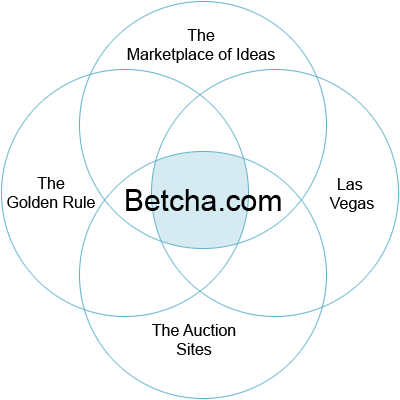
“As an open, honor-based betting platform, Betcha is like an auction site, Las Vegas, a marketplace of ideas, and The Golden Rule — all rolled into one. [1]
[1] “The Golden Rule” refers to the idea that you should do unto others as you’d have them do unto you. It is the fundamental principle behind most of the world’s major religions. And while we aren’t here to push religion on anyone, doing well by others is a principle we’d like to see more of.
Whaa? Four (weak) analogies plus a long-winded footnote? C’mon, Betcha, please KISS.
Talk about the danger of overfitting: "Complex and esoteric even in the world of technical indicators, the Hindenburg Omen is triggered when [four narrow conditions] occur"... "The Hindenburg Omen has a roughly 25% accuracy rate in predicting big market upheaval since 1987."... Is that precision or recall or ? See also http://en.wikipedia […]
"We design probabilistic computers, a new class of hardware and software that embraces uncertainty to generate inferences. Unlike current computers, which are built for logical deduction and precise arithmetic with no room for ambiguity, our computers are built for guessing the meaning behind inherently ambiguous data. Our first product, Veritable, solv […]
Betcha's gambit
Betcha is bold. To say the least. The founder Nick Jenkins is either crazy, brilliant, or, like many founders, both. Betcha is a platform for peer to peer betting not unlike gottabet, betfair, or intrade. Except for two (intimately related) details: (1) all debts are on the honor system, and (2) it’s based in Seattle, WA, UIGEA. Betcha makes no bones about it ( no “wink wink” here): they expect users to bet on anything and everything including sports. But because coughing up is not strictly enforced, the site evades the letter of the gambling laws. To engender trust, Betcha verifies its users’ credit cards and tracks their reputation scores, but in the end all payments are voluntary. The site earns money via listing fees.
I can’t help but admire Jenkins and Co., and I hope their gambit succeeds: my heart is with them even if my head is a step behind. (For more legal discussion see Tom Bell and The Boston Globe.)
And as much as I like the concept, I do have to ding Betcha for one of the most convoluted, head-scratching explainers I’ve heard in a long time:
Whaa? Four (weak) analogies plus a long-winded footnote? C’mon, Betcha, please KISS.