Oddhead Logo

Oddhead Blog

Musings of a computer scientist and yahoo1,2 about
prediction markets, gambling, and estimating the odds of everything

October 30th, 2008

Find where your polling place isn’t

Just in time for Election Day Tuesday November 4, 2008, here is an extremely un-useful mapping service to help you find exactly where not to go on election day in order to cast your vote.

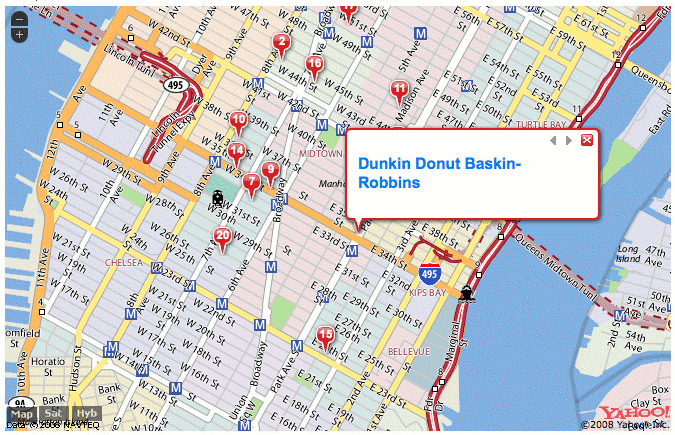
For example, here is precisely where I would not go to vote if I lived where I work which I don’t:

Map Where Dave's Polling Place is Not


Ok, what’s the point of this you ask?

Well, first, there is little point — it’s mostly a joke.

Beyond that, it’s meant as a satirical commentary on the inability of computers to understand satirical commentary.

Search engine algorithms and search advertising algorithms can’t distinguish well between “polling place is” and “polling place is not”.

Enough googlebombing and I’d wager the above link could rise in the ranks for search queries like polling place.

Enough money and a griefer serious about policing the Internet’s un-seriousness could advertise the link to people searching for their polling place in battleground zip codes, keeping the ad text perfectly factual with a few well placed negations, bypassing human editors at least for a few crucial hours.

In a way, it’s a thought experiment into our future as robots replace humans in the workforce, in this case librarians and editors.

The site is not meant to fool people, even foolish people, only computers.

October 25th, 2008

Not the lesser of two evils

Every election, many voters rationalize their choice as the “lesser of two evils”.1

However, for me, this year’s election is not about the lesser of evils.

In fact, for the first time I can remember, I actually like both major candidates in the US Presidential election.

I like Obama more and I voted for him2 — I think he’s smarter, inspires optimism, and has better policies and people surrounding him. But I like many aspects of McCain including how he denounced Pat Robertson, Jerry Falwell, and the extreme religious right they represent.3

If the party of less government could ever manage to stop legislating morality, I might actually consider voting for them. By the opposite logic, I imagine some evangelicals actually hope that Obama wins, thus strengthening their argument that Republicans can’t win without them.

On a related note, I received an email chain letter from a Snopes-averse source4 warning that McCain’s campaign is sending out erroneous absentee ballot applications to Obama supporters in an attempt to disqualify voters. Initially I dismissed it as conspiracy theory. Then, a few days ago, I received an absentee ballot application in the mail myself, even though I had just finished voting! For a moment, I thought I was a target of the scam with the evidence right in my hand. I could feel the blograge composing in my head.

So I investigated. (Read: conducted a few web searches.)

The Wisconsin State Journal (in)concludes that McCain either meddled or messed up, with benefit of the doubt going to the latter. Blackboxvoting.com (not affiliated with Bev Harris’s more cited blackboxvoting.org) paints a picture of more widespread fraud and malicious intent.

And it seems that the application I received was a legitimate and well intentioned mailing from the League of Conservation Voters Education Fund, a left-leaning environmental organization. The application’s return address had one line missing and an incorrect zip code by one digit, but the address was “correct” in the sense that it would almost surely end up at the right place, so I believe this was not part of any intentional plot to mislead.5 Still, the whole ordeal got me thinking that perhaps all unsolicited applications for absentee ballots should be outlawed — there’s just too much room for error, both malicious and inadvertent.

1Likely more a testament to the effectiveness of attack ads than anything else, and one of the many maddening features of a duop-racy.
2If the choice had been between Clinton and McCain, I think I would have had a harder decision.
3I also like the fact that he defied Bush on torture and held firm on the Iraq surge, a strategy that seems to have helped, despite the political consequences. On the other hand, I cringe at the thought of a President Palin, an outcome with a better than 1 in 7 chance of happening if elected, according to one estimate.
4My mom! :-)
5You decide: The return address on the application is: Middlesex County Clerk, PO Box 1110, New Brunswick, NJ 08903-1110. The correct address is County Clerk, Hon. Elaine Flynn, P.O. Box 1110, 75 Bayard Street, 4th Floor, New Brunswick, NJ 08901-1110.
October 10th, 2008

NYCE Day: Thanks and thoughts

NYCE Day 2008 went very well, with over 100 attendees, great talks, and valuable discussion. Many thanks to the four plenary speakers — Costis, Asim, Susan, and Tuomas — and ten rump session speakers who came in from various NYC suburbs like Boston, Pittsburgh, and Palo Alto.

At dinner the night before,1 the organizers agreed that we were nervous because we weren’t at all nervous. Karin and Renee from the New York Academy of Sciences had taken care of almost everything, leaving little for us to fret about. It turned out we were right to not worry and wrong to worry about not worrying: indeed Karin, Renee, and NYAS were absolutely fantastic, orchestrating every detail of the event flawlessly, from technology to catered breaks. The venue itself is gorgeous — a well laid-out space in a modern building in the World Trade Center complex with stunning views2 and a number of nice touches, from an alcove with a computer station to check email to a subtle gradient in the wallpaper that slowly pixilates as your gaze moves from the center toward the side of the room. I came away incredibly impressed with NYAS and delighted to become a member.

Muthu provides an excellent summary of the event, divided into before and after lunch. Read that first and then come back here for my additional thoughts/notes:

  1. Costis gave us mostly bad news. He summarized some of his award winning work with Christos Papadimitriou and Paul Goldberg proving that computing equilibrium behavior in almost any moderately complex game may be beyond the reach of our computers,3 let alone our brains. As a saying goes, “if your laptop can’t find it, then neither can the market” [attribution: Kamal Jain?]. Still, all may not be lost. These results, as is the nature of computational complexity results, say only that some games are extremely hard to solve, not all games or even most games. Since nature is not adversarial (Murphy’s Law aside), it may be the case that among games that arise in the real world that we care about, a number of them can be solved for equilibrium. The problem is defining what “realistic” means in this context: an almost impossibly fuzzy task. Costis did end with some positive results, showing that anonymous games can be solved efficiently. Anonymous games crop up in realistic situations, for example in analyzing traffic, where only the quantity of cars near you matters and not the identity of the drivers inside.

  2. Asim described a sophisticated Bayesian model well suited for social network data that handles non-existant links — meaning the lack of connection between two people, by far the most common situation — much better than previous approaches. The approach is good for digging deeply into a small data set but at least for now has difficulty with moderately large amounts of data. (To get results in a reasonable amount of time, Asim had to down sample his already fairly modest sized corpus.) The talk didn’t help me overcome my bias that Bayesian methods ala UAI often don’t work well at Internet scales without modification.

  3. Susan gave a fantastic and energetic talk. She advocates economic models of online advertising that include more sophisticated users, as opposed to typical models that assume users scan from the top of the page down in a precise sequence. She went further to claim that users may actually choose their search engine based on the quality of the ads. Personally, I’m a bit skeptical about that, though I do agree that there is an indirect effect: search engines with better paying ads can afford to buy more traffic and improve their algorithmic search more. Susan highlighted the enormous shift in mindset required between economic theory and practice when just computing the mean of a data stream can take weeks (though this is changing with tools like Hadoop that can bring such computations down to hours or minutes as Sebastien confirms).

  4. Someone asked Tuomas why his expressive commerce company CombineNet uses first-price auctions instead of VCG pricing. He listed four of what he said were dozens of reasons on top of Rothkopf’s thirteen and Ausubel and Milgrom’s list. In fact he went further to say that as far as he knew no real auction anywhere in the world has ever used true VCG pricing for anything more complicated than selling a single good at a time.

  5. For those not familiar, a rump session is open to anyone to speak briefly on any relevant topic. As it turns out, in part because brevity forces clarity, and in part because editorial filtering overweights mediocrity, the rump session is often the most interesting part of a conference. The “NYCE rump” session was no exception, with topics spanning ad auctions, reputation, Internet routing, and user generated content. Ivy Li proposed a clever scheme whereby eBay sellers are motivated to reward buyers for honest feedback. Sebastien presented work with Sihem and I on an expressive bidding language for online advertising with fast allocation and pricing algorithms, with the goal of moving the industry toward an open standard. Sampath Kannan on leave at NSF had encouraging news on the funding front, laying out his vision for CS theory funding with an explicit call for proposals at the boundary of CS and economics.

  6. I think we did a good job of attracting a diversity of speakers and participants, with talks ranging from computational complexity to Bayesian models of social networks, with academia and industry represented, and with CS, economics, and business backgrounds represented.
1We had dinner at Gobo, a fantastic restaurant Muthu recommended that truly opened my eyes in terms of the tastes and textures possible with a vegetarian menu. Delicious.
2Speaking of views, I had a stunning and fascinating one from my hotel the night before, looking straight down onto ground zero of the World Trade Center complex from a relatively high floor of the Millenium Hilton (apparently intentionally misspelled). I booked the room for $185 on Hotwire, and then found out why. Though the WTC site still looks nearly empty, builders appear to be making up for lost time with round the clock construction. Put it this way: the hotel kindly provided complementary earplugs. All in all though the room and view were well worth the cost in dollars and sounds.
3Specifically, computing Nash equilibrium is PPAD-complete for most games. In terms of complexity classes, PPAD is a superset of P and a subset of NP. Almost surely there is no polynomial time algorithm, though the problem is not quite as hard as the classic NP-complete problems like traveling salesman.
October 1st, 2008

Reminder: NYCE Day and nicer views Oct 3 2008

If you were wavering on whether to attend NYCE Day (New York Computer Science and Economics Day) this Friday October 3, take a look at the New York Academy of Sciences venue where the event will be held. It’s spectacular.

Hope to see many folks there.

New York Academy of Sciences view

October 1st, 2008

Even the stock market doesn’t know how to report prices

The debate over how to report prediction market prices may seem to arise only because so many of the markets have low liquidity. If prediction markets were more liquid, the logic goes, then it wouldn’t matter if observers reported the last trade price, the average of the last several prices, or the bid-ask spread: they’d all be roughly the same. Indeed, in the extreme case of an “infinite liquidity” automated market maker, they are all the same.

Lance encountered the problem when a few rogue trades caused the colors on our electoral markets map to swing in what would seem to be irrational ways, briefly painting California red for McCain, for example.

However yesterday proved that even one of the most traded stocks on one of the largest volume financial exchanges in the world can suffer from bizarre trading oddities that make reporting meaningful prices an exercise in ad hockery.

It seems that Google’s stock gyrated wildly near the close of trading in entirely inexplicable ways that seem impossible to rationalize, and all this despite enormous volume traded. From SeekingAlpha:

[Here are] the official [NASDAQ] datapoints: share volume of 12 million shares (that’s about $5 billion), more than double the normal amount; an intraday high of $489, and — most improbable of all — an intraday low of just 1 cent per share.

What I found most incredible is that NASDAQ actually rewrote history in response:

Sep 30, 2008 17:01:02 ET Pursuant to Rule 11890(b) NASDAQ, on its own motion, has determined to cancel all trades in security Google Inc Cl - A “GOOG” at or above $425.29 and at or below $400.52 that were executed in NASDAQ between 15:57:00 and 16:02:00 ET. In addition, NASDAQ will be adjusting the NASDAQ Official Closing Cross (NOCP) and all trades executed in the cross to $400.52. This decision cannot be appealed. MarketWatch has coordinated this decision to break trades with other UTP Exchanges. NASDAQ will be canceling trades on the participant’s behalf.

I had no idea that stock exchanges canceled trades “just because”. Barring system error, this seems just plain wrong — certainly worthy of serious outrage from traders. If someone agrees to trade at a wildly irrational price that’s their own problem and they should have to live with it.

Apparently it’s not only possible, but common. On the same day NASDAQ canceled trades in ROH deemed out of bounds:

Sep 30, 2008 17:14:37 ET Pursuant to Rule 11890(b) NASDAQ, on its own motion, has determined to cancel all trades in security Rohm and Haas Company (ROH) at or above $73.20 and at or below $68.93 that were executed in NASDAQ between 15:57:00 and 16:02:00 ET. This decision cannot be appealed.

Suddenly our hack fix to the electoral markets map* and the various controversial revisions at intrade and betfair [1, 2] don’t seem quite so crazarbitrary in comparison.

*We now report the last trade price only if it falls between the current bid-ask spread, otherwise we report the bid or ask price, whichever is closer to the last price. After all, if the last price falls outside the bid-ask boundaries, it no longer reflects current market sentiment.