
Review of Fortune’s Formula by William Poundstone: The stranger-than-fiction tale of how to invest
What is a better investment objective? Grow as wealthy as possible as quickly as possible, or Maximize expected wealth for a given time period and level of risk The question is at the heart of a fight between computer scientists and economists chronicled beautifully in the book Fortune’s Formula by Pulitzer Prize nominee William Poundstone. [...]
What is (and what good is) a combinatorial prediction market?
What exactly is a combinatorial prediction market? 2010 Update: Several of us at Yahoo! Labs, along with academic researchers, have theorized and written about combinatorial prediction markets for several years, as you’ll see below. But now we’ve gone beyond talking about them and actually built one. So the best way to answer the question is [...]
The right way to implement a multi-outcome prediction market: Linear programming
There are many examples of multi-outcome prediction markets, for example election markets with more than two candidates, or sports championship markets with dozens of teams. What is the best way to implement a multi-outcome prediction market? The simplest way is to effectively ignore the fact that there are multiple outcomes, breaking up the market into [...]
The wisdom of the ProbabilitySports crowd
One of the purest and most fascinating examples of the “wisdom of crowds” in action comes courtesy of a unique online contest called ProbabilitySports run by mathematician Brian Galebach. In the contest, each participant states how likely she thinks it is that a team will win a particular sporting event. For example, one contestant may [...]
Evaluating probabilistic predictions
A number of naysayers [Daily Kos, The Register, The Big Picture, Reason] are discrediting prediction markets, latching onto the fact that markets like TradeSports and NewsFutures failed to call this year’s Democratic takeover of the US Senate. Their critiques reflect a clear misunderstanding of the nature of probabilistic predictions, as many others [Emile, Lance] have [...]
Implementing Hanson's Market Maker
Robin Hanson invented a wonderful market maker well suited for use in prediction market applications with a long name: the logarithmic market scoring rule market maker, which I’ll abbreviate as LMSR. (In fact, Hanson invented an entire class of market scoring rule market makers, but the logarithmic variant seems the most useful.) Hanson’s two papers [...]
| © 2010 Oddhead Blog | Suffusion WordPress theme by Sayontan Sinha |
Find where your polling place isn't
Just in time for Election Day Tuesday November 4, 2008, here is an extremely un-useful mapping service to help you find exactly where not to go on election day in order to cast your vote.
Click here to find where your polling place isn’t for this election
For example, here is precisely where I would not go to vote if I lived where I work which I don’t:
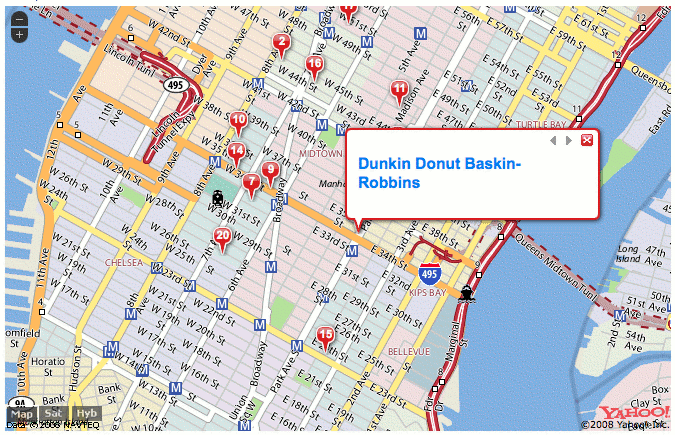
Ok, what’s the point of this you ask?
Well, first, there is little point — it’s mostly a joke.
Beyond that, it’s meant as a satirical commentary on the inability of computers to understand satirical commentary.
Search engine algorithms and search advertising algorithms can’t distinguish well between “polling place is” and “polling place is not”.
Enough googlebombing and I’d wager the above link could rise in the ranks for search queries like polling place.
Enough money and a griefer serious about policing the Internet’s un-seriousness could advertise the link to people searching for their polling place in battleground zip codes, keeping the ad text perfectly factual with a few well placed negations, bypassing human editors at least for a few crucial hours.
In a way, it’s a thought experiment into our future as robots replace humans in the workforce, in this case librarians and editors.
The site is not meant to fool people, even foolish people, only computers.