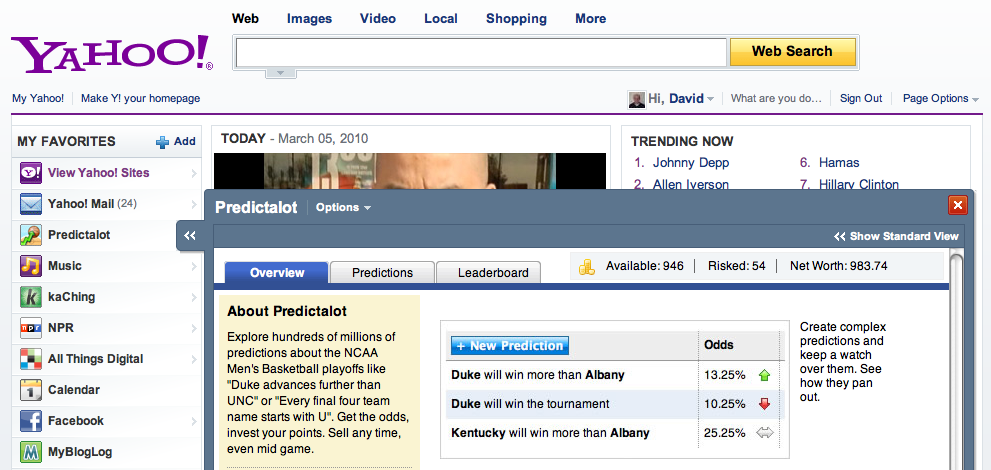
I’m thrilled to announce the launch of Predictalot, a combinatorial prediction market for the NCAA Men’s Basketball playoffs. Predict almost anything you can think of, like Duke will advance further than UNC, or Every final four team name will start with U. Check the odds and invest points on your favorites. Sell your predictions anytime, even as you follow the basketball games live.
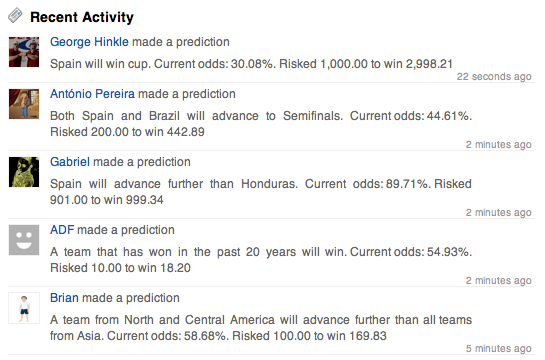
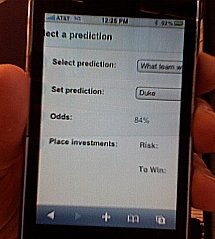
The basic game play is simple: select a prediction type, customize it, and invest points on it. Yet you’ll never run out of odds to explore: there are hundreds of millions of predictions you can make. The odds on each update continuously based on other players’ predictions and the on-court action.
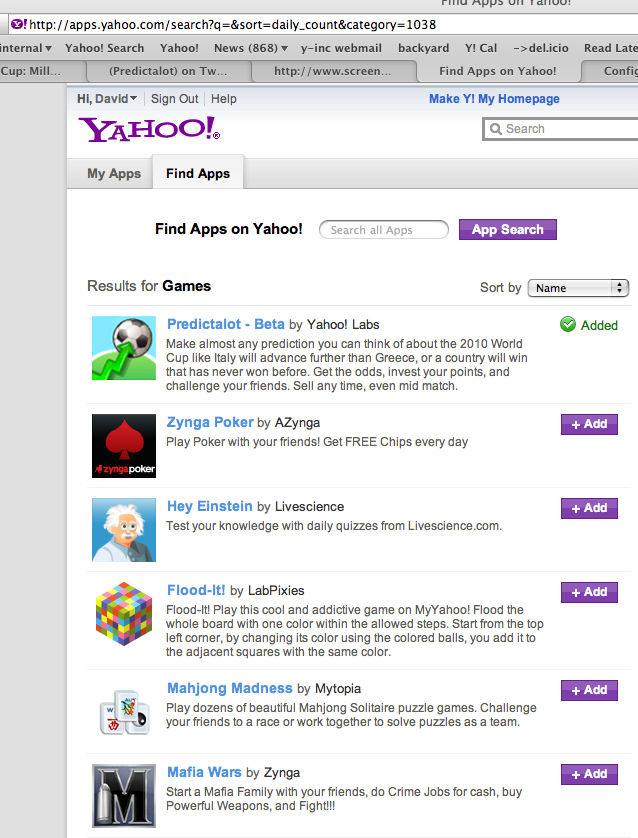
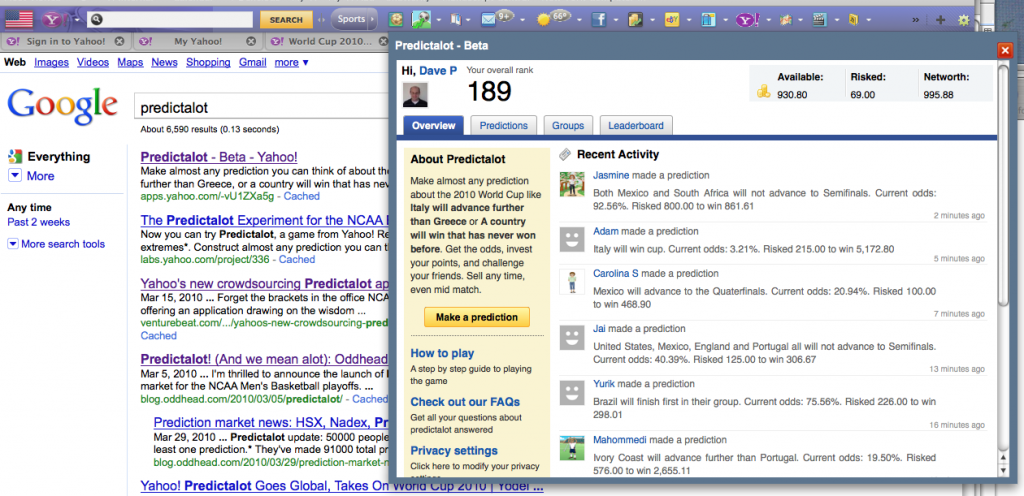
Predictalot is a Yahoo! App, so you can play it at apps.yahoo.com or you can add it to your Yahoo! home page. I have to admit, it’s an incredible feeling to play a game I helped design right on the Yahoo! home page.

That’s all you need to get started. If you’re curious and would like a peek under the hood, read on: there’s some interesting technology hidden in the engine.
Background and Details
Predictalot is a true combinatorial prediction market of the sort academics like us and Robin Hanson have been dreaming about since early in the decade. We built the first version during an internal Yahoo! Hack Day. Finally, we leveraged the Yahoo! Application Platform to quickly build a public version of the game. (Note that anyone can develop a YAP app that’s visible to millions — there’s good sample code, it supports YUI and OpenSocial, and it’s easy to get started.) After many fits and starts, late nights, and eventually all nights, we’re proud and excited to go live with Predictalot version 1.0. I can’t rave enough about the talent and dedication of the research engineers who gave the game a professional look and feel and production speed, turning a pie-in-the-sky idea into reality. We have many features and upgrades in mind for future versions, but the core functionality is in place and we hope you enjoy the game.
In the tournament, after the play-in game, the 64 top college basketball teams play 63 games in a single elimination tournament. So there are 2 to the power 63 or 9.2 quintillion total possible outcomes, or ways the entire tournament can unfold. Predictalot implicitly keeps track of the odds for them all. To put this in perspective, it’s estimated that there are about 10 quintillion individual insects on Earth. Of course, for all practical purposes, we can’t store 9.2 quintillion numbers, even with today’s computers. Instead, we compute the odds for any outcome on the fly by scanning through the predictions placed so far.
A prediction is a statement, like Duke will win in the first round, that will be either true or false in the final outcome. In this case, the prediction is true in exactly half, or 2 to the power 62 outcomes. (Note this does not mean the odds are 50% — remember the outcomes themselves are not all equally likely.) In theory, Predictalot can support predictions on any set of outcomes. That’s 2 to the power 2 to the power 63, or more than a googol predictions. For now, we restrict you to “only” hundreds of millions of predictions categorized into thirteen types. Computing the odds of a prediction precisely is too slow. Technically, the problem is #P-hard: as hard as counting SAT and harder than the travelling salesman problem. So we must resort to approximating the odds by randomly sampling the outcome space. Sampling is a tricky business — equal parts art and science — and we’re still actively exploring ways to increase the speed, stability, and accuracy of our sampling.
Because we track all possible outcomes, the predictions are automatically interconnected in ways you would expect. A large play on Duke to win the tournament instantly and automatically increases the odds of Duke winning in the first round; after all, Duke can’t win the whole thing without getting past the first round.
With 9.2 quintillion outcomes, Predictalot is to our knowledge the largest prediction market built, testing the limits of what the wisdom of crowds can produce. Predictalot is a game, and we hope it’s fun to play. We’d also like to pave the way for serious use of combinatorial prediction market technology.
Why did Yahoo! build this? Predictalot is a smarter market, letting humans and computers each do what they do best. People enter predictions in simple terms they understand like how one team fares against another. The computer handles the massive yet methodical number crunching needed to combine all the pieces together into a coherent overall prediction of a complex event. Markets like Predictalot, WeatherBill, CombineNet, and Internet advertising systems, to name a few, represent the evolution of markets in the digital age, empowering users with extreme customization. More and more, matching buyers with sellers — the core function of markets — requires sophisticated algorithms, including machine learning and optimization. Predictalot attempts to illustrate this trend in an entertaining way.
David Pennock
Mani Abrol, Janet George, Tom Gulik, Mridul Muralidharan, Sudar Muthu, Navneet Nair, Abe Othman, Daniel Reeves, Pras Sarkar
2 weeks, 2 geeks: My two new fearless leaders
Well, geeks are certainly inheriting my earth.
On January 13, my company named Carol Bartz, a self-avowed math nerd and former punch-card carrying member of her college computer club, as its CEO. In her own words:
Exactly one week later, on January 20, my country turned over executive control to Barack Obama, a CrackBerry addicted comic book geek. In his inauguration speech, Obama vowed to “restore science to its rightful place”, “wield technology’s wonders”, and even addressed “non-believers” — wording that in any sane universe should be entirely unremarkable, yet in ours appears to represent an unprecedented milestone.
I can’t recall a two-week span filled with so much geek pride and cautious optimism.
Back to the Carol Bartz quote. Reading it brings a smile to my face. It also reminds me of my mom, who, convinced it was her only option, taught middle school for a few years before returning to medical school to pursue her passion, enjoying a successful career as one of the first women radiologists.
I highly recommend Bartz’s essay, which mixes biography with prescience and insight. Bartz describes how technology and the Internet are transforming collaboration and improving productivity, at the same time ushering in an era of information overload, email bankruptcy, and misuse of the extra time technology affords. Remarkably, she wrote about these things in 1997!
It’s amazing to think how things have changed since 1997. My own first web experience, courtesy Mosaic, came in 1994, the same year Yahoo! was founded. In 1996, PayPal predecessor and public company First Virtual wrote their own keystroke-sniffing malware as a stunt to bolster their urgent call to “NEVER TYPE YOUR CREDIT CARD NUMBER INTO A COMPUTER”. Ebay was founded in 1995, PayPal in 1998. In 1997, Friendster had neither come nor gone, and Facebook CEO Mark Zuckerberg was 13.
Yet Bartz’s words seem more relevant than ever today.