It’s true.

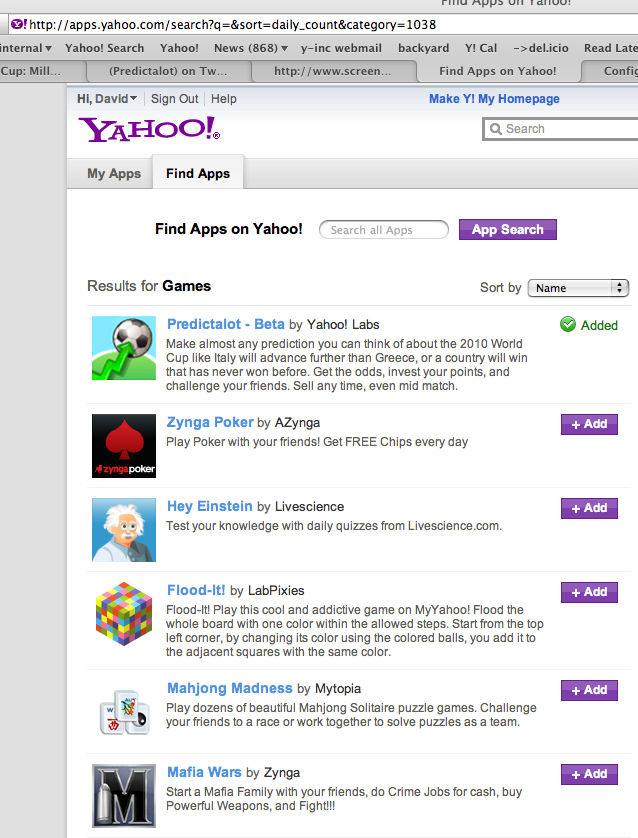
More people are playing Predictalot today than Mafia Wars or Zynga Poker… On Yahoo!, that is.

In fact, Predictalot is the #1 game app on Yahoo! Apps by daily count. By monthly count, we are 5th and rising.

A prediction is being made about every three minutes.

Come join the fun.

predictalot most popular game app on yahoo 2010-06-12

I just left the 2010 ACM Conference on Electronic Commerce, where six (!) out of 45 papers were about prediction markets.

Yahoo! Lab’s own Predictalot market is now live and waiting for you to place almost any prediction your heart desires about the World Cup in South Africa.

Here are some terribly useful things you can learn this time around. All numbers are subject to change, and that’s kind of the point:

  • There’s a 37% chance Brazil and Spain will both make it to the final game; there’s only a 15% chance that neither of them will make it
  • There’s is a 1 in 25 chance Portugal will win the cup; 1 in 50 for Argentina
  • 42.92% chance that a country that has never won before will win
  • 19.07% chance that Australia will advance further than England
  • 65.71% chance that Denmark, Italy, Mexico and United States all will not advance to Semifinals
  • Follow Predictalot on twitter for more

If you think these odds are wrong, place your virtual wager and earn some intangible bragging rights. You can sell your prediction any time for points, even in the middle of a match, just like the stock market.

There are millions of predictions available, yet I really believe ours is the simplest prediction market interface to date. (Do you disagree, Leslie?) We have an excellent conversion rate, or percent of people who visit the site who go on to place at least one prediction — for March Madness, that rate was about 1 in 5. One of our main goals was to hide the underlying complexity and make the app fast, easy, and fun to use. I personally am thrilled with the result, but please go judge for yourself and tell us what you think.

In the first version of Predictalot, people went well beyond picking the obvious like who will win. For example, they created almost 4,000 “three-dimensional” predictions that compared one team against two others, like “Butler will advance further than Kentucky and Purdue”.

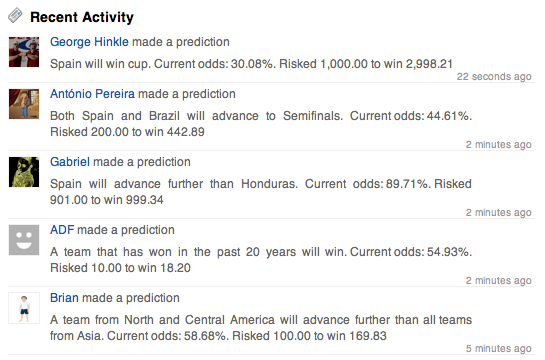
If you’re not sure what to predict, you can now check out the streaming updates of what other people are predicting in your social circle and around the world:

Predictalot recent activity screenshot 2010-06-11 18:45

Also new this time, you can join a group and challenge your friends. You can track how you stack up in each of your groups and across the globe. We now provide live match updates right within the app for your convenience.

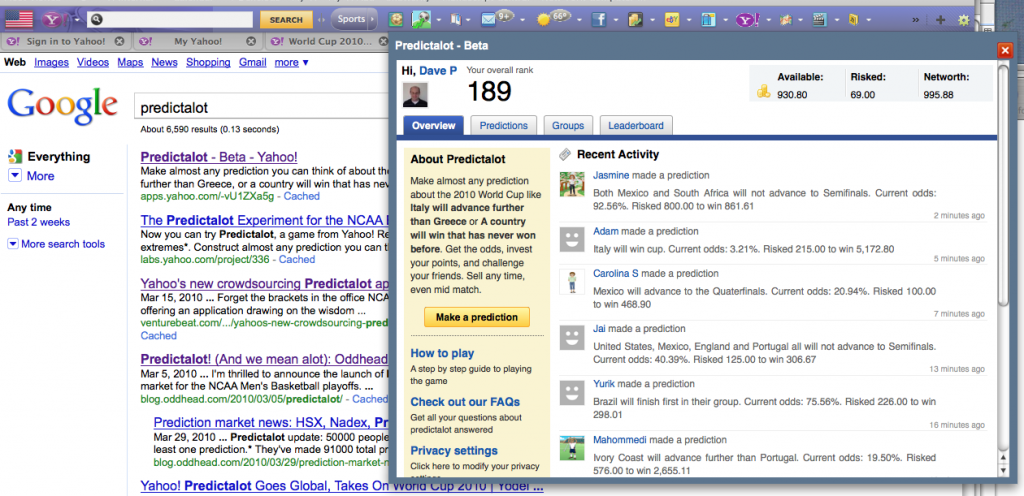
If you have the Yahoo! Toolbar (if not, try the World Cup toolbar), you can play Predictalot directly from the toolbar without leaving the webpage you’re on, even if it’s Google. ;-)

playing predictalot from the yahoo! toolbar

Bringing Predictalot to life has been a truly interdisciplinary effort. On our team we have computer scientists and economists to work out the market math, and engineers to turn those equations into something real that is fast and easy to use. Predictalot is built on the Yahoo! Application Platform, an invaluable service (open to any developer) that makes it easy to make engaging and social apps for a huge audience with built-in distribution. And we owe a great deal to promotion from well-established Yahoo! properties like Fantasy Sports and Games.

We’re excited about this second iteration of Predictalot and hope you join us as the matches continue in South Africa. We invite everyone to join, though please do keep in mind that the game is in beta, or experimental, mode. (If you prefer a more polished experience, check out the official Yahoo! Fantasy Sports World Soccer game.) We hope it’s both fun to play and helps us learn something scientifically interesting.

Read more here, here, and here.

Or watch a screencast of how to play:

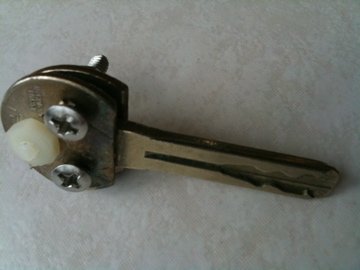
My dad is an original maker. When I didn’t want to pay $200 to replace a broken car key housing, he sent me this vice made out of quarters he fashioned and all the parts I needed to attach it to the key.

Using quarters as a vice to hold a key

Aa biomedical engineer, he led a study showing that a non-invasive mask can save people from respiratory failure as well as intubation. The technique is now common practice and, fittingly, the device helped saved his own life several years ago. He also invented a piezoelectric band to measure heart rate and breathing during sleep more comfortably than electrodes.

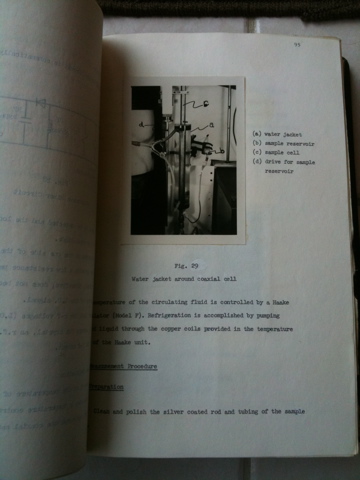
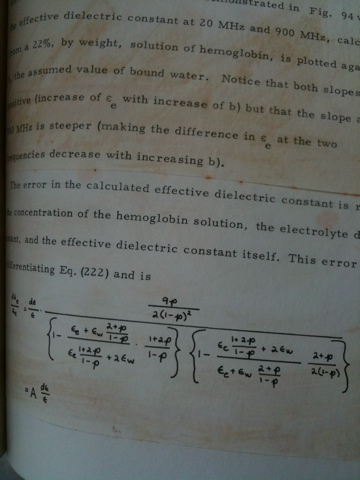
He did his Ph.D. dissertation on, in a sense, protien folding, in the days when cut and paste meant scissors and glue. I have an original copy of his dissertation and it’s a beautiful object to behold.

Bernie Pennock's Ph.D. dissertation 1Bernie Pennock's Ph.D. dissertation 2Bernie Pennock's Ph.D. dissertation 3

And what about that blowtorch fountain?

Bernie Pennock and the Blowtorch Fountain

Read about it in this profile of my dad by Maureen Simpson highlighting both his hacker and painter sides.

In his retirement, Bernie Pennock found a way to turn fire into water.
The former medical research scientist said it was just one of the many problems that needed solving in his home, where art has become the answer.
“It’s really the same idea as what I did as a career,” Pennock said of his hobby. “You see a problem and think of how to solve it. I think of what I want to do and how to do it, and then I do it and see if it works.”
Using old brass blowtorches he has collected over the years from antique shops and friends, Pennock constructed a fountain next to the pathway leading up to his front door…
Instead of spitting flames, Pennock’s structure spouts water. He mounted the old-fashioned tools to a sheet of copper and then rigged a water pump and pipes behind it… Pennock said his friends describe the work of art as “very Rube Goldberg.”…
Inside his home — on lampshades, along walls and attached to windows — guests can see numerous examples of the former scientist’s artistic experiments. His most recent obsession, apart from the fountain, has been working with stained glass.
“It all started with this window that looks out on the pool,” Pennock said. “I wanted something that let in light, but wouldn’t allow you to see into the bathroom. When I got an estimate to find out how much it would cost to have someone do a stained glass window, I decided to make my own.”
The multi colored scene is based on a photograph Pennock took of two people walking on the beach. Since then, he has made at least a dozen more windows that include a copy of a Monet painting, the Talmadge Bridge in Savannah and his interpretation of
12 stained glass windows designed by Marc Chagall at the synagogue of the Hadassah-Hebrew University Medical Center in Jerusalem, Israel.
Pennock said he usually buys the windows from a Habitat for Humanity store and gets his stained glass from a supplier in Charleston. The next project he plans to take on is a bamboo sculpture, because he’s running out of windows.
“I dabble in a lot of things,” Pennock said. “I like to invent. I just start from scratch, get ideas and see what happens.”
Among his rules for living, which Pennock painted on leftover floor tiles that hang next to the blowtorch fountain, is fittingly: “Pay attention.”

Oh, my brother and sister are makers too. And my mom a trailblazer. I’ll leave those for another day.

__________
This more personal post inspired because Robin says Tyler says it’s OK.

Sixty-five men’s college basketball teams have been selected. Tomorrow there will be sixty-four. Half of the remaining teams will be eliminated twice every weekend for the next three weekends until only one team remains.

On April 5th, we will know who is champion. In the meantime, it’s anybody’s guess: any of 9.2 quintillion things could in principle happen.

At Predictalot it’s your guess. Make almost any prediction you can think of, like Duke will win go further than both Kansas and Kentucky, or the Atlantic Coast will lose more games than the Big East. There’s even the alphabet challenge: you pick six letters that include among them the first letters of all four final-four teams.

Following Selection Sunday yesterday, the full range of prediction types are now enabled in Predictalot encompassing hundreds of millions of predictions about your favorite teams, conferences, and regions. Check it out. Place a prediction or just lurk to see whether the crowd thinks St. Mary’s is this year’s Cinderella.

Come join our mad science experiment where crowd wisdom meets basketball madness. We’ve had many ups and down already — for example sampling is way trickier than I naively assumed initially — and I’m sure there is more to come, but that’s part of what makes building things based on unsolved scientific questions fun. Read more about the technical details in my previous posts and on the Yahoo! Research website.

And for the best general-audience description of the game, see the Yahoo! corporate blog.

Update: Read about us on the New York Times and VentureBeat.

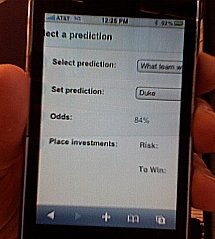
You can even get your fix on Safari on iPhone!

Dave playing Predictalot on iPhone

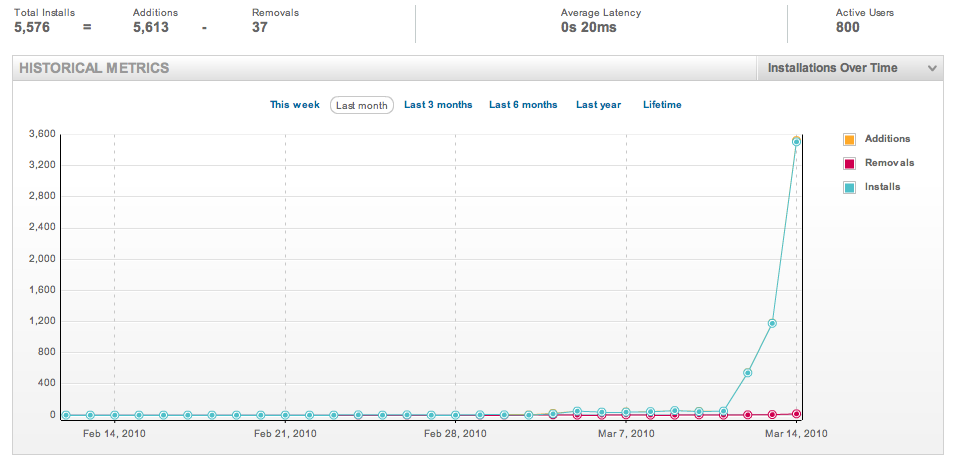
Below is a graph of our exponential user growth over the last couple days. Come join the stampede!

graph of YAP installs for Predictalot

I’m thrilled to announce the launch of Predictalot, a combinatorial prediction market for the NCAA Men’s Basketball playoffs. Predict almost anything you can think of, like Duke will advance further than UNC, or Every final four team name will start with U. Check the odds and invest points on your favorites. Sell your predictions anytime, even as you follow the basketball games live.

The basic game play is simple: select a prediction type, customize it, and invest points on it. Yet you’ll never run out of odds to explore: there are hundreds of millions of predictions you can make. The odds on each update continuously based on other players’ predictions and the on-court action.

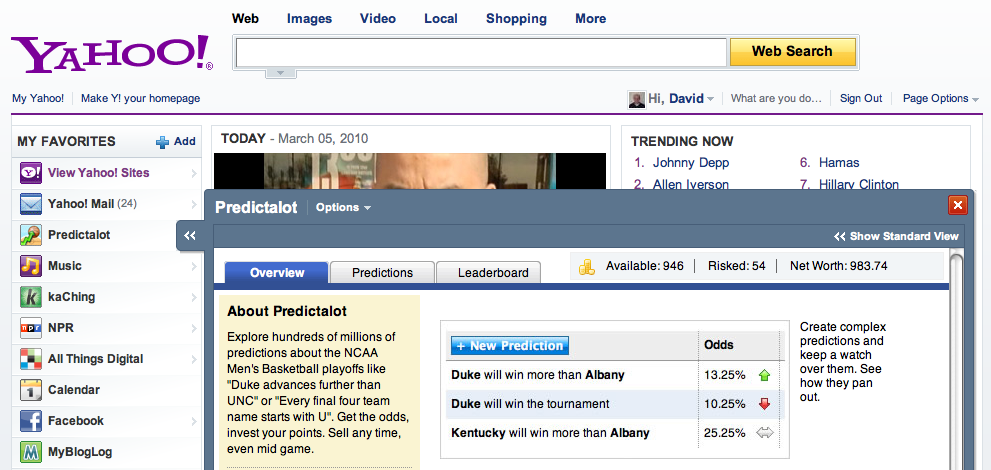
Predictalot is a Yahoo! App, so you can play it at apps.yahoo.com or you can add it to your Yahoo! home page. I have to admit, it’s an incredible feeling to play a game I helped design right on the Yahoo! home page.

Predicalot app on the Yahoo! home page

That’s all you need to get started. If you’re curious and would like a peek under the hood, read on: there’s some interesting technology hidden in the engine.

Background and Details

Predictalot is a true combinatorial prediction market of the sort academics like us and Robin Hanson have been dreaming about since early in the decade. We built the first version during an internal Yahoo! Hack Day. Finally, we leveraged the Yahoo! Application Platform to quickly build a public version of the game. (Note that anyone can develop a YAP app that’s visible to millions — there’s good sample code, it supports YUI and OpenSocial, and it’s easy to get started.) After many fits and starts, late nights, and eventually all nights, we’re proud and excited to go live with Predictalot version 1.0. I can’t rave enough about the talent and dedication of the research engineers who gave the game a professional look and feel and production speed, turning a pie-in-the-sky idea into reality. We have many features and upgrades in mind for future versions, but the core functionality is in place and we hope you enjoy the game.

In the tournament, after the play-in game, the 64 top college basketball teams play 63 games in a single elimination tournament. So there are 2 to the power 63 or 9.2 quintillion total possible outcomes, or ways the entire tournament can unfold. Predictalot implicitly keeps track of the odds for them all. To put this in perspective, it’s estimated that there are about 10 quintillion individual insects on Earth. Of course, for all practical purposes, we can’t store 9.2 quintillion numbers, even with today’s computers. Instead, we compute the odds for any outcome on the fly by scanning through the predictions placed so far.

A prediction is a statement, like Duke will win in the first round, that will be either true or false in the final outcome. In this case, the prediction is true in exactly half, or 2 to the power 62 outcomes. (Note this does not mean the odds are 50% — remember the outcomes themselves are not all equally likely.) In theory, Predictalot can support predictions on any set of outcomes. That’s 2 to the power 2 to the power 63, or more than a googol predictions. For now, we restrict you to “only” hundreds of millions of predictions categorized into thirteen types. Computing the odds of a prediction precisely is too slow. Technically, the problem is #P-hard: as hard as counting SAT and harder than the travelling salesman problem. So we must resort to approximating the odds by randomly sampling the outcome space. Sampling is a tricky business — equal parts art and science — and we’re still actively exploring ways to increase the speed, stability, and accuracy of our sampling.

Because we track all possible outcomes, the predictions are automatically interconnected in ways you would expect. A large play on Duke to win the tournament instantly and automatically increases the odds of Duke winning in the first round; after all, Duke can’t win the whole thing without getting past the first round.

With 9.2 quintillion outcomes, Predictalot is to our knowledge the largest prediction market built, testing the limits of what the wisdom of crowds can produce. Predictalot is a game, and we hope it’s fun to play. We’d also like to pave the way for serious use of combinatorial prediction market technology.

Why did Yahoo! build this? Predictalot is a smarter market, letting humans and computers each do what they do best. People enter predictions in simple terms they understand like how one team fares against another. The computer handles the massive yet methodical number crunching needed to combine all the pieces together into a coherent overall prediction of a complex event. Markets like Predictalot, WeatherBill, CombineNet, and Internet advertising systems, to name a few, represent the evolution of markets in the digital age, empowering users with extreme customization. More and more, matching buyers with sellers — the core function of markets — requires sophisticated algorithms, including machine learning and optimization. Predictalot attempts to illustrate this trend in an entertaining way.

David Pennock
Mani Abrol, Janet George, Tom Gulik, Mridul Muralidharan, Sudar Muthu, Navneet Nair, Abe Othman, Daniel Reeves, Pras Sarkar

Here are my notes from Yahoo! Open Hack Day NYC. For other perspectives read New York Times open sourcerer Nick Thuesen or the Yahoo! devel blog. You can watch videos of some of the talks or browse pictures.

First off, I cheated. I went to sleep in a hotel room rather than hack all through the night. (Even in college I woke up at 4am rather than pull an all nighter.) Still, I made decent progress on some pet projects including combinatorial betting. Daniel, Sharad, and Winter from Yahoo! Research New York participated for real, working through the night. Returning in the morning showered and caffeinated to greet the sleepwalkers was a little surreal. A number of ex-Yahoos joined the festivities including David Yang, Mor Naaman, and Chad Dickerson. (Havi joked that Yahoo! is like finishing school for entrepreneurs. If you count Yahoo! capture and releases like Mark Cuban and Paul Graham, the spreading influence is enormous.)

Clay Shirky kicked off the event. He’s a fantastic speaker — watch his talk here. His punch line — that successful communities like facebook, twitter, flickr, and wikipedia start small and cohesive (as opposed to large and fragmented: see Yahoo! 360) — was aimed perfectly at the many founders and foundreamers in the audience. There were speakers from Mint and foursquare and tutorials on the Yahoo! Application Platform, Yahoo! Query Language (the most popular service), Yahoo! TV widgets, and more. There was a round of Ignite NYC, a barrage of twenty-slides-in-five-minutes talks, some educational (geek’s guide to patents), some charitable (aid to South America), some hilarious (spaceman from outerspace), some thought provoking (makerbot 3d printers), and many all of the above (meta mechanical turk; the Emoji translation of Moby Dick). Watch the Ignite talks here.

A bunch of small touches made the event memorable, including a steampunk-themed hacking hall complete with retroRed Victorian couches, portraits of hackers through history, funky tweet-streaming sculptures, chalk drawings of old patents, power cords dangling from hanging bird cages, and a guitarhero-foosball corner. The food was tasty and at times eccentric, like the hot dog stand and toppings bar under a rainbow umbrella, ice cream cart, and old-fashioned popcorn machine. There was plenty of beer, coffee, red bull, sliders, and cookies, and even (gasp) vegan fare, salmon, and salad.

I give the event an A for style (decor, food) and content (talks, hacks, organization). The one sour note was the wireless — certainly a key ingredient for a good hack day — which began flaky and ended slow but acceptable.

I attended the YAP tutorial and created a rudimentary application. I was pleasantly surprised how simple the process was — the documentation and sample code are great. You can get the hello world app (complete with social hooks) running and add some ajax magic within minutes.

By far one of the coolest sights was the MakerBot Industries 3D printer in action. It sucks in plastic wire, melts it, and deposits it in perfect formation to produce coins, busts, parts for itself, or almost anything in the thingiverse. For Hack Day, the device printed news headlines in peanut butter on toast. We met an nyc resistor who was working on a conveyer belt mechanism for his own MakerBot printer, and he invited us to craft night at their shared hackspace in Brooklyn (a place that would be heaven for my dad and brother; Sharad, Jake, Daniel, and Bethany went to check it out).

I missed the tutorial on Yahoo! TV widgets but I’d like to learn more. They are now in most major TV brands including Sony, Samsung, and LG — millions of sets around the world in the coming months. (The Sony won editor’s choice in the Sept 2009 issue of Wired magazine; the Samsung and LG rated close behind. The sole TV reviewed without Yahoo! Widgets, a Panasonic, was ridiculed for is clunky Viera Cast online interface.) If you’re an internet video startup, like my friend, you need a widget channel. Personally, I’d love to see a sports game tracker that highlights pivotal moments by monitoring in-game betting odds.

Footnote: Two Yahoos made a humorous video (that’s both self-promotional and -deprecating) on what people in Times Square think ‘hacker’ means:

See Paul Tarjan and Christian Heilmann for real definitions.

Yahoo! Open Hack Day NYC 2009Join us on October 9, 2009 at the Millennium Broadway Hotel in New York City for Yahoo! Open Hack Day NYC. Come to listen, learn, and meet, but mainly come to make. Your goal: in 24 hours hackmash something together for bragging rights and prizes. Speakers include Clay Shirky (NYU), Carrie Cronkey (Mint.com), Dennis Crowley (foursquare), and Rasmus Lerdorf (inventor PHP). Register here. It’s free.

The 24-Hour Hackathon begins Friday afternoon. We encourage you to play around with Yahoo!’s Open Platforms and APIs like YAP, YQL, YUI, TVWidgets, our Social APIs, and more. And of course, feel free to use other APIs, developer tools and whatever software/hardware floats your boat…

At the end of the 24 hours, the hackers will have the chance to debut their hack and winners will be awarded with some enviable prizes…

And of course we will keep you well fed and hydrated throughout the two days. There will also be sleeping areas in case you want to take a nap.

Previous: the what and why of Open Hack.

As part of an internal hack day I’ve been diving back into greasemonkey, and remembering how much the monkey mentality changes the way you think about the web. Greasemonkey seems to have lost some mindshare momentum, probably due to a natural hype/fatigue cycle, the still minority share of Firefox browsers, and the very real “laziness barrier” that keeps the vast majority of people from installing new stuff.

In any case, rediscovering how easy it is to muck with any and every website, usually for fun, and sometimes to truly improve usability or productivity, brings back the giddy avalanche of ideas of ways to “reclaim the web”.

For example, it wouldn’t be terribly hard to add a bit of xmlhttpRequest to WebVocab to create a shortcut that, with one click, inserts a custom signature into any comment you leave on any web page, at the same time notifying your favorite social feed service (e.g., friendfeed, Facebook, Yahoo! updates) and/or your own server of the comment location and content. Your friends see where and what you’re commenting, and you get a searchable archive of all the breadcrumbs you leave around the web. It’s like a comment aggregator service that users control rather than publishers, and thus that works on any website, putting the user back into user-generated content.

Yahoo! Open Hack Day 2008 As Jed points out, “an idea is only the first step in innovation, and it’s by far the easiest step”.

Yahoo! Hack Day was created precisely to summon and celebrate the hard step of innovation: the build it step. The goal is simple: take an idea and make it real — in 24 hours. Spend all day and all night coding until a working, useable, if brittle prototype of your idea emerges. Then show it off.

Hack Day is a religion inside Yahoo!, but on September 12-13, 2008, Yahoo! will open up its Sunnyvale campus, inviting any developer who feels like it to join the geek-out frenzy. Sign up here.

Schedule

8am-6pm PT Friday: Over 20 workshops covering YUI and the newest API offerings from Yahoo!, including BOSS, SearchMonkey, Fire Eagle, and more, and previews of what’s next.

8pm Friday: A surprise musical guest takes the stage (it’s not 2006 guest Beck, but apparently the lyrics are “hacker-friendly” and “may not be appropriate for young children”). Hacking continues all night.

2pm Saturday: Judging, including a special hack-off for the winners of the University Hack Days.

Saturday evening: Awards.

History, thoughts, and notes

At the first Open Hack Day in 2006 in Sunnyvale (see photos), 400 developers fueled by 500 pizzas and a live Beck performance cranked out 54 hacks. At Open Hack Day London lightening struck twice and it rained indoors. Bangalore followed.

If you’re a student, Yahoo! Hack Week may be coming to a campus near you. We’ve held Hack Weeks at Georgia Tech, CMU, UIUC, UC Berkeley, and Stanford, and I believe Waterloo is next. Here’s a quote describing these Hack U events: “Computer science students fueled by fast food, ultra-caffeinated beverages, and alternative music, are free to let their imaginations run wild, tapping the Yahoo! library of APIs to create hacks that advance the Internet experience.”

Why Hack Day? Many an engineer join Jed in lamenting how the PowerPointy set co-opted the term innovation, rendering it almost meaningless. Hack Day was created in part to reclaim innovation for the makers.

Why does it work? Hack Day is to programmers what NaNoWriMo is to writers: a timed artistic challenge that on it’s face is a ludicrous and artificial pretense for accomplishing a goal. Yet somehow the exercise induces a psychological state perfect for making progress on the initial “80% phase” of creation. The punishing deadline forces all meta processing aside — no critic, no perfectionist, no planner, no lazy dreamer — and encourages the raw energy embodied by Nike’s Kirk-beats-Spock slogan “just do it”.

A number of Yahoo! products, services, and features were born on a Hack Day (here are two). Yoopick was too.

Why open?

Openness is one of only three overarching goals for Yahoo!. The other two goalsstarting point for users and must buy for advertisers — are in some sense incontrovertible, yet the openness goal reflects a riskier “if we build it they will come” stand that’s grounded in Yahoo!’s respect for and debt of gratitude to Internet culture. Open Hack Day, Hadoop, Pig, cloud computing, academic relations, publications, APIs, BOSS, SearchMonkey, YUI, Pipes, OpenSocial, and OpenID are among the many examples showing that Yahoo!’s commitment to openness is real. (Jeremy, RIP 2008, said it better.)

Update 2008/09/11: Blueprint mobile SDK and more Y! Open announcements (music, homepage, mail, ads)

Update 2008/09/26: CNET says: Yahoo Open: Finally, a real answer to Google. Also, Google spouse Kara Swisher gets defensive and rewrites history.

Translate this Page

© 2010 Oddhead Blog Suffusion WordPress theme by Sayontan Sinha