We’re soliciting research paper submissions and participants for the Third Workshop on Sponsored Search, to be held May 8, 2007 in Banff, Canada, in conjunction with the 16th International World Wide Web Conference (WWW2007). The workshop will have an academic/research bent, though we welcome both researchers and practitioners from academia and industry to attend to discuss the latest developments in sponsored search research. Attendance will be open to all WWW2007 registrants.

See the workshop homepage for more details and information.

Sponsored search is a multi-billion dollar industry in rapid growth. Typically, web search engines auction off advertising space next to their standard algorithmic search results. Most major search engines, including Ask, Google, Microsoft, and Yahoo!, rely on sponsored search to monetize their services. Advertisers use sponsored search to procure leads and manage their customer acquisition process. Third party search engine marketers (SEMs) help advertisers manage their keyword portfolios and bidding campaigns. Academic work on sponsored search has only recently begun.

You can indicate your intent to attend at upcoming.org, though please note that official registration must go through the WWW2007 conference.

Hope to see you in Banff!

DictionaryIf a Frenchman with a jolly name can coin a term, then so can I. And so I did. In a previous post:

…no matter how surprised industry watchers were at the blogomediasphere’s glowing reception of the [iPhone]…

As it turns out, it looks like at least three others have already coined the term independently, to me a positive sign that it has a certain natural ring to it. What does it mean? A shorthand for “blogosphere and traditional media” that reflects the increasingly blurry lines between them, and the symbiotic echo chamber than has grown to encompass both.

Whiners who detest the words blog and blogosphere will hate this one even more. I personally like it (enough to place a small, good-natured wager). Who wants to write the Wikipedia entry? ;-)

I’ve been MarginalRevolutioned and kottked [?]. ;-) Welcome!

Time 2006 Person of the Year coverI finally read Time Magazine’s 2006 Person of the Year issue (as usual, I’m a month behind this guy). By now you know that the Person of the Year is “You”, meaning Internet users, meaning that user-generated content (UGC) is King.

There are some high points. Brian Williams, an old-media icon, clearly gets how his industry is changing, though his main point — that society is splintering into information silos where people “consume only what [they] wish to see and hear” — feels overblown: is the silo effect really any worse than it used to be when information was less accessible? Another op ed by Steven Johnson argues that UGC is largely filling a new niche rather than displacing professional content, and I tend to believe him. The YouTube creation story is fascinating, and seems more carefully done than the typical tales, which apparently leave out one of the three co-founders. The most entertaining piece is by Joel Stein about his foray into Second Life: hilarious!

My main complaint lies in Time’s choice of exemplars of the new world order. While YouTube is a no-brainer selection, a wonderful service, and a global phenomenon accelerated by Google’s name and $1.65 billion, Time appoints YouTube the protagonist and crown jewel, to the point where it feels like YouTube, not You, is the real Person of the Year. Meanwhile, MySpace and Yahoo! actually serve more videos to more people. Although these numbers reflect all videos, not just user-generated videos, the most popular items on YouTube are mainly not user-generated either. And it’s too early to judge YouTube’s monetize-ability and legal standing. Time even declares NetFlix a representative company. While NetFlix is certainly a great LongHighNew TailTechMedia company (I’m a subscriber), it’s not exactly indicative of UGC.

Flickr and del.icio.us are highlighted, though I don’t believe either is explicitly identified as a Yahoo! company (whereas the GooTube marriage figures prominently). In fact, I don’t recall Yahoo! being mentioned by name at all in the issue. (At this point readers may chalk up my complaint as a petty defensive gripe, and I don’t blame you: it’s certainly partly that.) So is Yahoo! failing in its publicly avowed strategy to embrace UGC and social media in a big way?

I don’t believe so. The *.yahoo.com family (still the #1 web property worldwide) is brimming with UGC: Answers, Finance, GeoCities, Groups, Local, Movies, Music, My, MyWeb, 360, Video, etc.

Yahoo! Answers by itself is now the 100th most visited web domain, capturing a 96% share of Q&A services, a growth area that already dominates traditional web search in some Asian countries. Yahoo!’s UGC strategy is perhaps most clear in its acquisitions: Flickr, del.icio.us, Konfabulator, JumpCut, Bix, MyBlogLog, etc. Mix in Yahoo!’s developer network, RSS fanaticism, and open spirit, and I find it hard to think of a company more representative of the user-genera-nation.

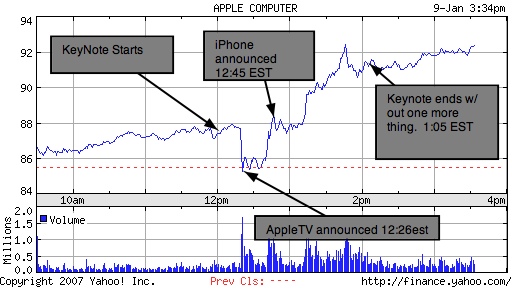
I’m a big believer in the efficient market hypothesis, but IMHO Wall Street’s rapture following Steve Jobs’s sermon and the ensuing iPhone idol worship cannot possibly be explained by rational behavior. Take a look at this graph (via Midas Oracle via Silicon Valley Watcher via ValleyWag courtesy Yahoo! Finance — long live remix!):

Annotated graph of Apple's stock price during Steve Jobs's first unveiling of the iPhone, Jan 2007

Overall, Apple’s stock was up over 11% in the two days following the iPhone announcement. C’mon: no matter how closely Apple guarded the iPhone’s specs, no matter how persuasive Jobs’s rhetoric, no matter how surprised industry watchers were at the blogomediasphere’s glowing reception of the gadget, Jobs’s speech could not possibly have revealed over $8 billion in previously undisclosed information. Certainly non-insiders knew some of the details of the iPhone. Almost everyone knew that Apple would announce some sort of cell phone / iPod combo device. Moreover, the thing is not even going on sale until the summer, and then with a single carrier at a price point sure to discourage mass consumption. I’m an Apple fan, an Apple Computer Inc. investor, a Mac user for decades (and an Apple II user before that), and I’m drooling along with the rest of you over the iPhone. But still, some of that sudden $8 billion re-assessment of Apple’s worth surely stems from irrational exuberance, herding, and/or good old fashioned religious fervor.

Readers may challenge me to put my money where my mouth is and (short) sell Apple. Since I’m not doing that, take all of this with a grain of salt.

Here is a fluffy post for a fluffy (but important) topic: the economics of attention.

Yahoo! is in the business of monetizing attention: that’s essentially what advertising is all about. We (Yahoo!) attract users’ attention by providing content, usually free, then diverting some of that attention to our paying advertisers. Increasingly users’ attention is one of the most valuable commodities in the world. This trend will only accelerate as energy becomes cheaper and more abundant, and thus everything we derive from energy (that is, everything) becomes cheaper and more abundant, on our way to a post-scarcity society, where attention is nearly the only constrained resource.

Today, users generally accept content and entertainment in return for their attention, though likely in the future users will be more savvy in directly monetizing their own attention. I’ve heard a number of companies and organizations large and small discuss direct user compensation. Beyond advertising, the economics of attention is important for the future of communication in general.

I haven’t found much academic writing on the topic, though I haven’t looked thoroughly. John Hagel’s piece “The Economics of Attention” is a good start, and he looks to have compiled some nice resources on the topic, though I haven’t yet investigated closely.

An organization that has garnered some attention of their own (of the Web 2.0 buzz variety) is Attention Trust. I find the description on their own website vague and impenetrable. The best explainer on Attention Trust I could find is PC4Media’s, though questions remain. The basic concept is simple enough: users should be empowered to control and monetize their own attention, including the output of their attention (e.g., their click trails, personal data, etc.). Just how Attention Trust plans to hand this power to the people seems to be the hand-wavy part of their story.

Another interesting company in this space is Root Markets, whose business is to connect both sides of the attention market in an attempt to commoditize attention. Their first product is much more specific than that: an exchange for mortgage leads.

If the absence of formal models of the economics of attention is real — and not simply a matter of my own ignorance — than it may be that some economist can make a career by truly tackling the topic in a precise and thorough way.

One of the purest and most fascinating examples of the “wisdom of crowds” in action comes courtesy of a unique online contest called ProbabilitySports run by mathematician Brian Galebach.

In the contest, each participant states how likely she thinks it is that a team will win a particular sporting event. For example, one contestant may give the Steelers a 62% chance of defeating the Seahawks on a given day; another may say that the Steelers have only a 44% chance of winning. Thousands of contestants give probability judgments for hundreds of events: for example, in 2004, 2,231 ProbabilityFootball participants each recorded probabilities for 267 US NFL Football games (15-16 games a week for 17 weeks).

An important aspect of the contest is that participants earn points according to the quadratic scoring rule, a scoring method designed to reward accurate probability judgments (participants maximize their expected score by reporting their best probability judgments). This makes ProbabilitySports one of the largest collections of incentivized1 probability judgments, an extremely interesting and valuable dataset from a research perspective.

The first striking aspect of this dataset is that most individual participants are very poor predictors. In 2004, the best score was 3747. Yet the average score was an abysmal -944 points, and the median score was -275. In fact, 1,298 out of 2,231 participants scored below zero. To put this in perspective, a hypothetical participant who does no work and always records the default prediction of “50% chance” for every team receives a score of 0. Almost 60% of the participants actually did worse than this by trying to be clever.
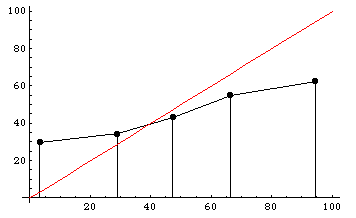
ProbabilitySports participants' calibrationParticipants are also poorly calibrated. To the right is a histogram dividing participants’ predictions into five regions: 0-20%, 20-40%, 40-60%, 60-80%, and 80-100%. The y-axis shows the actual winning percentages of NFL teams within each region. Calibrated predictions would fall roughly along the x=y diagonal line, shown in red. As you can see, participants tended to voice much more extreme predictions than they should have: teams that they said had a less than 20% chance of winning actually won almost 30% of the time, and teams that they said had a greater than 80% chance of winning actually won only about 60% of the time.

Yet something astonishing happens when we average together all of these participants’ poor and miscalibrated predictions. The “average predictor”, who simply reports the average of everyone else’s predictions as its own prediction, scores 3371 points, good enough to finish in 7th place out of 2,231 participants! (A similar effect can be seen in the 2003 ProbabilityFootball dataset as reported by Chen et al. and Servan-Schreiber et al.)

Even when we average together the very worst participants — those participants who actually scored below zero in the contest — the resulting predictions are amazingly good. This “average of bad predictors” scores an incredible 2717 points (ranking in 62nd place overall), far outstripping any of the individuals contributing to the average (the best of whom finished in 934th place), prompting someone in this audience to call the effect the “wisdom of fools”. The only explanation is that, although all these individuals are clearly prone to error, somehow their errors are roughly independent and so cancel each other out when averaged together.

Daniel Reeves and I follow up with a companion post on Robin Hanson’s OvercomingBias forum with some advice on how predictors can improve their probability judgments by averaging their own estimates with one or more others’ estimates.

In a related paper, Dani et al. search for an aggregation algorithm that reliably outperforms the simple average, with modest success.

     1Actually the incentives aren’t quite ideal even in the ProbabilitySports contest, because only the top few competitors at the end of each week and each season win prizes. Participants’ optimal strategy in this all-or-nothing type of contest is not to maximize their expected score, but rather to maximize their expected prize money, a subtle but real difference that tends to induce greater risk taking, as Steven Levitt describes well. (It doesn’t matter whether participants finish in last place or just behind the winners, so anyone within striking distance might as well risk a huge drop in score for a small chance of vaulting into one of the winning positions.) Nonetheless, Wolfers and Zitzewitz show that, given the ProbabilitySports contest setup, maximizing expected prize money instead of expected score leads to only about a 1% difference in participants’ optimal probability reports.

Translate this Page

© 2010 Oddhead Blog Suffusion WordPress theme by Sayontan Sinha

resume writing services