Oddhead Logo

Oddhead Blog

Musings of a computer scientist and yahoo1,2 about
prediction markets, gambling, and estimating the odds of everything

April 26th, 2008

Reporting prediction market prices

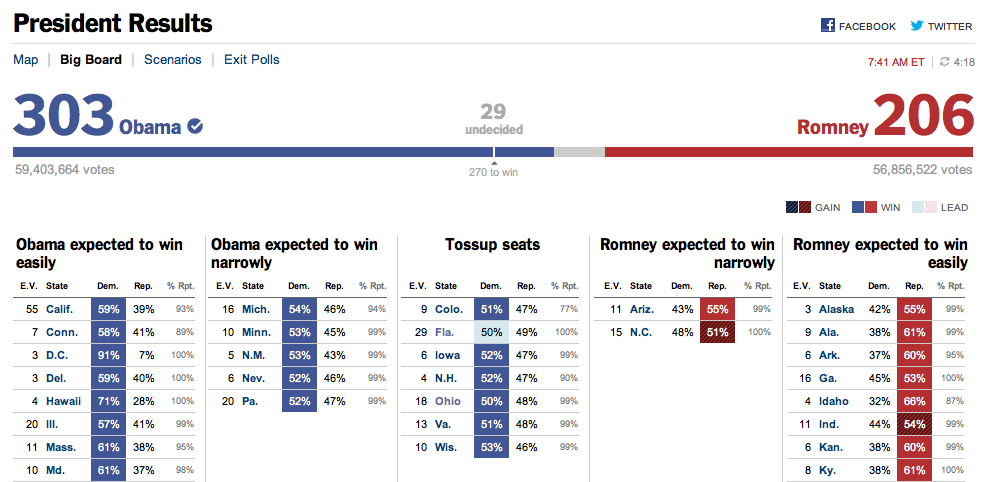
Reuters recently ran a story on political prediction markets, quoting prices from intrade and IEM. (Apparently the story was buzzed up to the Yahoo! homepage and made the Drudge Report.)

The reporter phrased prices in terms of the candidates’ percent chance of winning:

Traders … gave Democratic front-runner Barack Obama an 86 percent chance of being the Democratic presidential nominee, versus a 12.8 percent for Clinton…

…traders were betting the Democratic nominee would ultimately become president. They gave the Democrat a 59.1 percent chance of winning, versus a 48.8 percent chance for the Republican.

The latter numbers imply an embarrassingly incoherent market, giving the Democrats and Republicans together a 107.9% chance of winning. This is almost certainly the result of a typo, since the Republican candidate on intrade has not been much above 40 since mid 2007.

Still, typos aside, we know that the last-trade prices of candidates on intrade and IEM often don’t sum to exactly 100. So how should journalists report prediction market prices?

Byrne Hobart suggests they should stick to something strictly factual like "For $4.00, an investor could purchase a contract which would yield $10.00" if the Republican wins.

I disagree. I believe that phrasing prices as probabilities is desirable. The general public understands “percent chance” without further explanation, and interpreting prices in this way directly aligns with the prediction market industry’s message.

When converting prices to probabilities, is a journalist obligated to normalize them so they sum to 100? Should journalists report last-trade prices or bid-ask spreads or something else?

My inclination is that bid-ask spreads are better. Something like "traders gave the Democrats between a 22 and 30 percent chance of winning the state of Arkansas". These will rarely be inconsistent (otherwise arbitrage is sitting on the table) and the phrasing is still relatively easy to understand.

Avoiding this (admittedly nitpicky) dilemma is another advantage of automated market makers like Hanson’s. The market maker’s prices always sum to exactly 100, and the bid, ask, and last-trade prices are one and the same. Auction-type mechanisms like intrade’s can also be designed better so that prices are automatically kept consistent.

April 25th, 2008

A freakonomist takes on Big Weather and, … stumbles

It seems that even D.I.Y. freakonomists aren’t sure how to judge probability forecasts.

In measuring precipitation accuracy, the study assumed that if a forecaster predicted a 50 percent or higher chance of precipitation, they were saying it was more likely to rain than not. Less than 50 percent meant it was more likely to not rain.

That prediction was then compared to whether or not it actually did rain…

June 13th, 2007

Predicting media success

Often, predicting success is being a success. Witness Sequoia Capital or Warren Buffet.

In the media industry (e.g., books, celebs, movies, music, tv, web), predicting success largely boils down to predicting popularity.

Predicting popularity would be wonderfully easy, if it weren’t for one inconvenient truth: people herd. If only people were as fiercely independent as they sometimes claim to be — if everyone decided what they liked independently, without regard to what others said — then polling would be the only technology we would need. A small audience poll would foreshadow popularity with high accuracy.

Alas, such is not the case. No one consumes media in a vacuum. People are persuaded by influencers and influenced by persuaders. People respond in whole or in part to the counsel of critics, peers, viruses, and (yes) advertisers. So, what becomes popular is not simply a matter of what is good. What becomes popular depends on a complex dynamic process of spreading influence that’s hard to track and even harder to predict.

Columbia sociologist (and I’m happy to note future Yahoo) Duncan Watts and his colleagues conducted an artful studydescribed eloquently in the NY Times — asking just how much of media success reflects the true quality of the product, and how much is due to the quirks of social influence. In a series of carefully controlled experiments, the authors tease apart two distinct factors in a song’s ultimate success: (1) the inherent quality of the song, or the degree people like the song if presented it in isolation, and (2) dumb luck, or the extent the song happens by chance to get some of the best early buzz, snowballing it to the top of the charts in a self-fulfilling prophesy. Lo and behold, they found that, while inherent quality does matter, the luck of the draw plays at least as big a role in determining a song’s ultimate success.

If so, Big Media might be forgiven for their notoriously poor record of picking winners. Over and over, BM hoists on us stinkers like Gigli and stale knockoffs like Treasure Hunters. (In prediction lingo, these are false positives.) At the same time, BM snubbed (at least initially) some cultural institutions like Star Wars and Seinfeld. (False negatives.)

So, are media executives making the best of a bad situation, eking out as much signal as possible from an inherently noisy process? Or might some other institution yield forecasts with fewer false-atives?

I think you know where this is going. Prediction markets for media!

Media Predict is exactly that: a new prediction market aimed at forecasting media success. I’d like to congratulate founder Brent Stinski on a spectacular launch done right. Media Predict sprinted out of the gates with a deal with Simon & Schuster’s Touchstone Books and a companion piece in the NY Times, spawning coverage in The Economist and NPR. (Also congrats to Inkling Markets, the “powered by” provider.) More importantly, the website is clean, clear, complete (enough), and ready for launch.

I first met Brent Stinski in 2006 at Collabria’s NYC Prediction Markets Summit and his concept impressed me. Among the flury of recent play money PM startups, Media Predict’s business plan seems one of the most credible. The site taps simultaneously into the wisdom of crowds ethos, the user-generated content explosion, artists’ anti-establishment streak, and the public’s ambivalence toward Big Media. (The latter two factors are epitomized no more vehemently and eloquently than in an essay by Courtney Love, and stoke the fires of sites like Garage Band, Magnatune, Creative Commons, Lulu, Kinooga, and even MySpace, not to mention mashup fever, open source, anti-DRM-ism, etc.)

The New York publishing world is ridiculing Simon & Schuster for ceding its editorial power to the crowd. (In fact, S&S reserves the right to choose any book or none at all.)

Time will tell whether prediction markets can be better than (or at least more cost effective than) traditional media executives. One thing is for certain: one way or another, the power structure in the publishing world is changing rapidly and dramatically (no one sees and explains this better than Tim O’Reilly). My bet is that many artists and consumers will emerge feeling better than ever.

January 4th, 2007

The wisdom of the ProbabilitySports crowd

One of the purest and most fascinating examples of the “wisdom of crowds” in action comes courtesy of a unique online contest called ProbabilitySports run by mathematician Brian Galebach.

In the contest, each participant states how likely she thinks it is that a team will win a particular sporting event. For example, one contestant may give the Steelers a 62% chance of defeating the Seahawks on a given day; another may say that the Steelers have only a 44% chance of winning. Thousands of contestants give probability judgments for hundreds of events: for example, in 2004, 2,231 ProbabilityFootball participants each recorded probabilities for 267 US NFL Football games (15-16 games a week for 17 weeks).

An important aspect of the contest is that participants earn points according to the quadratic scoring rule, a scoring method designed to reward accurate probability judgments (participants maximize their expected score by reporting their best probability judgments). This makes ProbabilitySports one of the largest collections of incentivized1 probability judgments, an extremely interesting and valuable dataset from a research perspective.

The first striking aspect of this dataset is that most individual participants are very poor predictors. In 2004, the best score was 3747. Yet the average score was an abysmal -944 points, and the median score was -275. In fact, 1,298 out of 2,231 participants scored below zero. To put this in perspective, a hypothetical participant who does no work and always records the default prediction of “50% chance” for every team receives a score of 0. Almost 60% of the participants actually did worse than this by trying to be clever.

ProbabilitySports participants' calibrationParticipants are also poorly calibrated. To the right is a histogram dividing participants’ predictions into five regions: 0-20%, 20-40%, 40-60%, 60-80%, and 80-100%. The y-axis shows the actual winning percentages of NFL teams within each region. Calibrated predictions would fall roughly along the x=y diagonal line, shown in red. As you can see, participants tended to voice much more extreme predictions than they should have: teams that they said had a less than 20% chance of winning actually won almost 30% of the time, and teams that they said had a greater than 80% chance of winning actually won only about 60% of the time.

Yet something astonishing happens when we average together all of these participants’ poor and miscalibrated predictions. The “average predictor”, who simply reports the average of everyone else’s predictions as its own prediction, scores 3371 points, good enough to finish in 7th place out of 2,231 participants! (A similar effect can be seen in the 2003 ProbabilityFootball dataset as reported by Chen et al. and Servan-Schreiber et al.)

Even when we average together the very worst participants — those participants who actually scored below zero in the contest — the resulting predictions are amazingly good. This “average of bad predictors” scores an incredible 2717 points (ranking in 62nd place overall), far outstripping any of the individuals contributing to the average (the best of whom finished in 934th place), prompting someone in this audience to call the effect the “wisdom of fools”. The only explanation is that, although all these individuals are clearly prone to error, somehow their errors are roughly independent and so cancel each other out when averaged together.

Daniel Reeves and I follow up with a companion post on Robin Hanson’s OvercomingBias forum with some advice on how predictors can improve their probability judgments by averaging their own estimates with one or more others’ estimates.

In a related paper, Dani et al. search for an aggregation algorithm that reliably outperforms the simple average, with modest success.

     1Actually the incentives aren’t quite ideal even in the ProbabilitySports contest, because only the top few competitors at the end of each week and each season win prizes. Participants’ optimal strategy in this all-or-nothing type of contest is not to maximize their expected score, but rather to maximize their expected prize money, a subtle but real difference that tends to induce greater risk taking, as Steven Levitt describes well. (It doesn’t matter whether participants finish in last place or just behind the winners, so anyone within striking distance might as well risk a huge drop in score for a small chance of vaulting into one of the winning positions.) Nonetheless, Wolfers and Zitzewitz show that, given the ProbabilitySports contest setup, maximizing expected prize money instead of expected score leads to only about a 1% difference in participants’ optimal probability reports.
December 26th, 2006

Evaluating probabilistic predictions

A number of naysayers [Daily Kos, The Register, The Big Picture, Reason] are discrediting prediction markets, latching onto the fact that markets like TradeSports and NewsFutures failed to call this year’s Democratic takeover of the US Senate. Their critiques reflect a clear misunderstanding of the nature of probabilistic predictions, as many others [Emile, Lance] have pointed out. Their misunderstanding is perhaps not so surprising. Evaluating probabilistic predictions is a subtle and complex endeavor, and in fact there is no absolute right way to do it. This fact may pose a barrier for the average person to understand and trust (probabilistic) prediction market forecasts.

In an excellent article in The New Republic Online [full text], Bo Cowgill and Cass Sunstein describe in clear and straightforward language the fallacy that many people seem to have made, interpreting a probabilistic prediction like “Democrats have a 25% chance of winning the Senate” as a categorical prediction “The Democrats will not win the Senate”. Cowgill and Sunstein explain the right way to interpret probabilistic predictions:

If you look at the set of outcomes estimated to be 80 percent likely, about 80 percent of them [should happen]; events estimated to be 70 percent likely [should] happen about 70 percent of the time; and so on. This is what it means to say that prediction markets supply accurate probabilities.

Technically, what Cowgill and Sunstein describe is called the calibration test. The truth is that the calibration test is a necessary test of prediction accuracy, but not a sufficient test. In other words, for a predictor to be considered good it must pass the calibration test, but at the same time some very poor or useless predictors may also pass the calibration test. Often a stronger test is needed to truly evaluate the accuracy of probabilistic predictions.

For example, suppose that a meteorologist predicts the probability of rain every day. Now suppose this meteorologist is lazy and he predicts the same probability every day: he simply predicts the annual average frequency of rain in his location. He doesn’t ever look at cloud cover, temperature, satellite imagery, computer models, or even whether it rained the day before. Clearly, this meteorologist’s predictions would be uninformative and nearly useless. However, over the course of a year, this meteorologist would perform very well according to the calibration test. Assume it rains on average 10% of the time in the meteorologist’s city, so he predicts “10% chance” every day. If we test his calibration, we find that, among all the days he predicted a 10% chance of rain (i.e., every day), it actually rained about 10% of the time. This lazy meteorologist would get a nearly perfect score according to the calibration test. A hypothetical competing meteorologist who actually works hard to consider all variables and evidence, and who thus predicts different percentages on different days, could do no better in terms of calibration.

The above example suggests that good predictions are not just well calibrated: good predictions are, in some sense, both variable AND well calibrated. So what is the “right” way to evaluate probabilistic predictions? There is no single absolute best way, though several tests are appropriate, and probably can be considered stronger tests than the calibration test. In our paper “Does Money Matter?” we use four evaluation metrics:

  1. Absolute error: The average over many events of lose_PR, the probability assigned to the losing outcome(s)
  2. Mean squared error: The square root of the average of (lose_PR)2
  3. Quadratic score: The average of 100 - 400*(lose_PR)2
  4. Logarithmic score: The average of log(win_PR), where win_PR is the probability assigned to the winning outcome

Note that the absolute value of these metrics is not very meaningful. The metrics are useful only when comparing one predictor against another (e.g., a market against an expert).

My personal favorite (advocated in papers and presentations) is the logarithmic score. The logarithmic score is one of a family of so-called proper scoring rules designed so that an expert maximizes her expected score by truthfully reporting her probability judgment (the quadratic score is also a proper scoring rule). Stated another way, experts with more accurate probability judgments should be expected to accumulate higher scores on average. The logarithmic score is closely related to entropy: the negative of the logarithmic score gives the amount (in bits of information) that the expert is “surprised” by the actual outcome. Increases in logarithmic score can literally be interpreted as measuring information flow.

Actually, the task of evaluating probabilistic predictions is even trickier than I’ve described. Above, I said that a good predictor must at the very least pass the calibration test. Actually, that’s only true when the predicted events are statistically independent. It is possible for a perfectly valid predictor to appear miscalibrated when the events he or she is predicting are highly correlated, as discussed in a previous post.